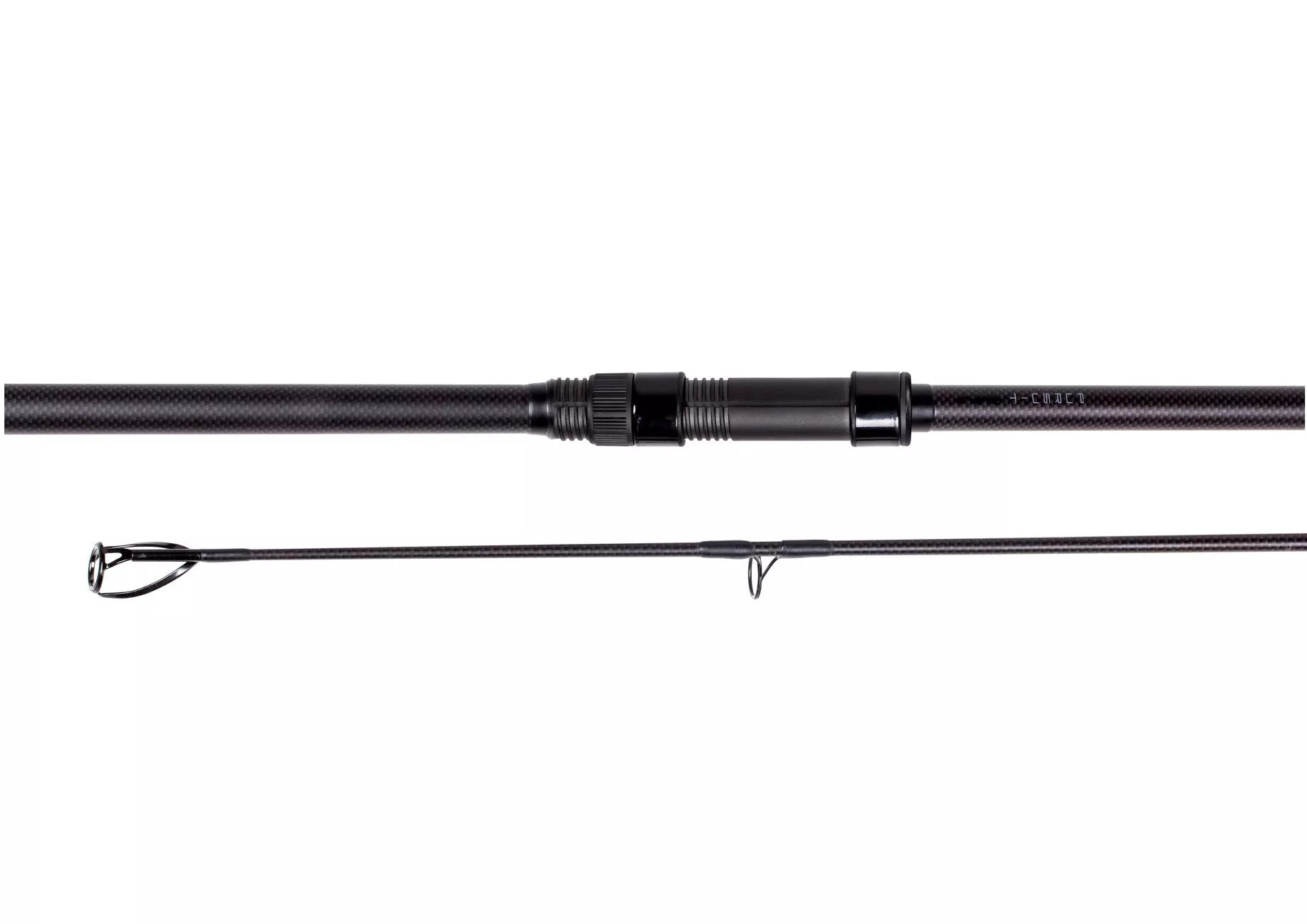
12 or 13 feet? 3lbs or 3.5? Two pieces or three pieces? Le questions, for those who are new to carp fishing and want to buy their first rod, there are many.
In this one guide to choosing carp fishing rod we will see some simple parameters to avoid mistakes.
Choosing the right carp fishing rod essentially depends on a factor: the environment (the waters) in which we fish.
Weight and height of the fisherman they also have an influence on the purchase of the rod (we talk about it in a specific paragraph), but the environment we frequent, therefore the type of carp fishing we practice, has much more importance: we will realize how much, in the same lake, quarry or river, we will be able to face all situations without ever doubting of our tool.
Specifically, they are three basic elements, in relation to the environment, which contribute to the definitive choice: we will see them one by one, giving some indications and giving several practical examples so you can choose from the wide assortment of carp fishing rods.

12 OR 13 FEET?
Taking a look at the market you immediately realize that modern rods Fishing to the carp they have essentially two measures: 12 feet, which corresponds to 3.6 meters, and 13 feet, which corresponds to 3.9 meters.
Wanting to give a general indication, the 12 foot rods they are the so-called allround, that is, they allow the fisherman to fully exploit the tool in any environment (regardless of height and weight, which we will talk about later).
Le 13 feet, on the contrary, are generally considered reeds "from throwing”, suitable for fairly tall fishermen (above six feet).
In recent years the market has then developed rods of other lengths, for specific uses.
Among these, it is very widespread the classic “middle ground”, i.e. 12.6 feet (3.75 metres), which is the preferred choice of those who want "all-round" tools but which also know how to give us something extra in casting.
Finally, there are the so-called "short rods”: the 11, 10 and 9 feet (3.3, 3 and 2.7 meters respectively) which, depending on the model, are perfect for being used by the boat (a rod of just three meters is easier to handle on a boat than a rod of almost four) or in the Fishing “stalking”, that is, with rapid movements in pursuit of the fish.
They are therefore rods with a small footprint, light and easy to handle, suitable for quick movements even in narrow places.
POUNDS, NOT GRAMS
Unlike other rods Fishing, for example those from Fishing at sea or by spinning, the power of the rods it is not expressed based on the maximum weight that these can throw but based on the so-called "pound weight".
The data is measured in this way: by placing the rod horizontally, parallel to the ground, an increasing weight (in pounds) is applied until an angle of 90° is created between the rod blank and the tip.
Generally carp fishing rods they range from a low of 1.75 pounds to a high of 5.5.
This means, for example, that a two-pound rod needs 907 grams of weight (453.5 grams, or one pound, multiplied by two) to bend 90 degrees.
The pounds most used are 3, 3.25 and 3.5 lbs. But be careful: the poundage only gives a rough indication of the casting power. Rather, it represents the power the rod has in retrieving.
Of course, 3.5 lb rods can cast heavier leads than 2.75 lb ones, but it is also true that, among 3.5 lb rods, there can be differences of up to 20 grams between the maximum weight cast. Because here action comes into play, which we will see in the next paragraph.
To conclude the topic of rod weight, let's do a little diagram which represents, on average, the weight range that the rods with the most popular poundages can cast.
- 2.5 pounds 60- 80 grams
- 3 pounds 90-110 grams
- 3.5 pounds 110-140 grams
- 5 pounds 170-250 grams

That said, every poundage has its own employment, which we summarize as follows:
- Rods from 1.5 to 2.5 pounds: they are tools for Fishing “light”, in small environments and at short distances, without the use of heavy ballast. At the same time, they are very "fun" rods, because they allow you to hear the fish's outbursts more. Some versions of these rods are made specifically for Fishing afloat and are much softer and more parabolic (we will see in a few lines what this means) than those, of the same poundage, created for the Fishing thoroughly;
- 2.75lb rods: classic tools Fishing in the quarry at medium-short distances. They are the favorites of those who love to "feel" all the power of hooked carp;
- 3lb rods: in one word, “allround”. The 3 pounds allow us to fish even at long distances and are not very hard "poles" that make us lose emotions in the fight;
- 3.25 and 3.50 pound rods: they are preferred by those who want to fish at long distances (because they are "harder" and more powerful) but also by those who need to force the carp a lot during the fight, for example when there is the risk of it slipping into submerged obstacles. They are also the right tools for Fishing with Pva bags at medium-long distances. They pay something, obviously, at the moment of the fight: they are less "fun" rods than the 3-pounders;
- 3.75 – 4.5 lb. rods: extreme gear, made especially for Fishing in places full of obstacles where the push and pull with the fish is very violent. Or, they are used to fish with large PVA bags, weighing up to 2 ounces, at great distances from the shore;
- Rods from 5lbs and up: they are the so-called "spod rods", created specifically to launch groundbait with rockets and Spombs (throwing baiters). These are very hard rods, which can even cast weights of 250 grams. Their specific use is that of baiting, generally they do not have an action suitable for fighting also because they are very tough and not very sensitive in the bend.
At this point, we arrive at the third fundamental element in choosing the rod: theaction, which we will discuss in the next paragraph.

PARABOLIC, PROGRESSIVE OR PEAK
The title is quite clear: generally carp fishing rods have one of these three types of action.
Le parabolic rods, as the name itself suggests, undergo a homogeneous arc: that is, when they come into traction for the heads of the fish, they all bend, up to the handle.
Le progressive, on the other hand, have a similar action to parabolics but they are much stiffer in the handle. We see them bend quite "softly" up to the junction between the two pieces of the rod, and then stiffen towards the reel.
If parabolic rods are considered rods with an "ancient" action, progressive rods are the most widespread and modern.
Le more extreme, however, are those ad flagship action.
These are purpose-made tools to throw at great distances and they are immediately recognizable because only the tip bends quickly, while the rest of the tool is rigid and gives a very accentuated sensation of power.
The latter rods are also called fast, or we find them under the acronym “LD, long distance”: once whipped to simulate the launch, we will realize that they will vibrate very little and will return to the starting position in a few seconds.
Parabolics, on the other hand, are considered "soft", because they vibrate much longer before returning to position.
Schematically, let's summarize which fishermen the various actions are "matched" to.
- Parabolic: suitable for those who think about having fun, they are the so-called "playing" rods, i.e. soft and sensitive, made specifically to enjoy the fight even with the smallest carp. They are not suitable for extreme uses or in situations where we are forced to cast long distances;
- Progressives: also known as parabolic-progressive, they are the all-round rods par excellence because they are both fun and performing in casting;
- Top of the line: these are the rods suitable for whom Fishing in extreme conditions, especially for long distances to be reached with your feet on the shore. They naturally require good throwing skills, otherwise their performance is not fully exploited.
Before concluding, a small clarification is necessary: the rods parabolic and progressive ones are more “forgiving” of errors of fishermen compared to the peak ones.
Thanks to their elasticity and delicate action, in fact, they are able to repair the angler's distraction errors, such as the clutch being too closed, the position of the wrong rod, or the use of braid on the reel.
For this reason, they are ideal for anglers who have recently approached carp fishing.
The choice of rod can therefore be made based on these three characteristics fundamentals. We add others, which we can define “accessories”, and which concern in particular the rings.

RING MATERIAL
Since they are often used in carp fishing braided wires, it is necessary that our rod is equipped with rings capable of resisting the rubbing of the wire on the same.
The braids, unlike monofilaments, are not smooth and behave like "saws", rubbing on the rings. They heat them and cut them: this is why poor quality rings are to be avoided.
Our rods need to be rigged rings capable of dispersing heat caused by the rubbing of the braids: the most widespread material in this regard is the silicon carbide (SiC).

DOUBLE OR SINGLE DECK
The first carp fishing rods had single-leg guides, today almost all tools have those double bridge.
The former have less influence on the action of the rod, because they rest on a single pin and do not "break" the action of the blank.
The double deck ones are obviously more solid, they resist wear better but they stiffen the stem.
The single bridge is a choice that few carp anglers make (and there are very few carp fishing rods with single bridge guides on the market).
50 MM RING, YES OR NO?
Debated topic: does the first 50 mm ring (i.e. the first after the reel going towards the tip) make you cast further?
The answer is yes, but only under two conditions: that the action of the rod is suitable for casting and that the matching reel has a large spool and perfect spooling.
The 50 mm rings were in fact created to respond to aneed: since big pit reels (those with a large and large spool, "stolen" from surf casting) are increasingly widespread in carp fishing, rings that reduce the friction of the wire coils to a minimum on the same.

In fact, a large coil corresponds to a large coil: this is why, the wire passes better through a 50 mm ring, simply because it does not "choke" the coil like a normal 35 or 40 mm ring would.
Be careful, though: the 50 mm ring helps but is not essential. Long casts depend more on the quality of the blank and the quality of the caster than on the diameter of the rings.
Before talking about practical cases, let's focus for a few seconds on physical characteristics of the fisherman, because these can also influence the choice of a rod.
With a premise: physical characteristics come into play when we talk about "advanced" carp fishing, that is, fishermen with a certain type of experience and with very clear ideas about the tool they need.
HIGH AND LOW
It is not a fundamental rule but, generally, “long” rods such as 13 feet are not recommended for anglers shorter than 1.75 meters.
The reason lies in ballistics. A cast is longer the wider the arc that the lead makes in its flight towards the water. And this arc is wider the longer the drop, i.e. the piece of line between the tip of the rod and the sinker.
In a normal overhead cast with suspended lead, in order to keep a long drop (generally stopping the lead at the junction between the two pieces of the rod) a fisherman is more advantaged if he is tall because, by stretching your arms, the barrel will be higher than the ground.
A 1.60 meter tall fisherman will have difficulty holding the drop so long because the lead will touch the ground at the moment of the push, nullifying the loading of the rod.
A shorter angler should shorten the drop, with the consequence of reducing the width of the arc, therefore reducing the maximum reachable distance.
So, if we wanted to follow this "rule", we should say this: 13 foot rods are good for anglers from 75 meters to 80 meters and above. For the "smaller" ones, 12 foot tools are better.

HEAVY AND LIGHT
Many believe that the long throw depends on arm strength, but this is not true: what does everything, or almost everything, is our weight.
If we are able to shift the weight correctly, we will load the rod the right way and cast further.
Here's why there are 70 kilo fishermen who cast further of 100-pound brawlers: it all lies in the technique and the ability to load the rod with our weight while moving forward.
When choosing a rod, especially if we want to exploit it 100 percent, weight plays a fundamental role. In fact, if we weigh 60 kilos it will be much more difficult to load a 3.5 pound rod than a 2.75-3 pound one, especially if we don't have a lot of experience casting with carp fishing rods behind us.
At the same time, if we weigh 90 or 100, a 3-pound rod will be undersized for our potential.
Even in this case, however, let's talk about "advanced" situations, that is, fishermen with experience capable of perfectly control your movements of launch and with specific needs to reach non-average distances.
But the rule is this: the "lighter" we are, the lower the poundage of the rod must be.

At the end of this long technical explanation, we provide you with some practical examples for choosing a carp fishing rod:
“I'm a novice and I need to buy my first carp fishing rod” – The advice we give you is to buy a 12 foot rod with 3lb power. It ensures that you can handle most situations. From quarries, where we assume carp anglers cut their teeth, to large lakes, where a little extra power is needed. As an action, choose a parabolic or a progressive one: they allow you to have more confidence in fighting carp, therefore to learn their behaviors beyond the line more quickly.
“I mostly frequent the small, hollow ones and fish from the bank” – In this case you need an allround rod. A 12 foot, 3 pound, parabolic-progressive is the one for you. If you want to have more fun with rod fish you can also buy a 2.75 pounder: naturally you will be slightly limited in the maximum weights you can cast;
“I only fish in large lakes, and I cast the lines with the boat” – You need a powerful tool, to hook fish at long distances, but with an action that is not too harsh, so a progressive one is what you need. A 3.25lb, or even 3.5lb 13 footer is more than fine. Also consider purchasing a 10-foot 3 or 3.5 pound rod: on a boat it is very easy to handle and allows total control of the prey;
“I always fish by casting, in medium-large waters, and I am forced to cast at great distances” – You need a powerful, fast rod, capable of transforming every drop of force you impart into the blank into metres. You need a tool with a fast, top-of-the-line action that can also cast 130 gram leads. A 13-foot 3.5-pounder is the one for you.
“I fish both in quarries and in lakes, but I want to have fun and feel every catch, without being too limited in range” – A parabolic 3-pounder might be ideal, but also consider a 2.75-pounder, also parabolic and 12 feet long. It is a handy tool that allows you to cast even at 70-75 meters.
“My favorite environment is the river, I fish in the strong current and also in the oxbows” – The type of characteristic needed in this case is only one: power. That's why we recommend a rod of at least 3.5 pounds. As regards the length, our advice is to stay around 13 feet, because the underbank in rivers is often full of boulders and submerged obstacles: a longer (and progressive) rod helps us manage the prey better in the final stages of the fight, protecting us from unhooking.
“La Fishing static isn't for me. I like looking for carp and fishing for them with refined approaches and I like to always be on the move” – You need a light, easy to handle and fast rod. Power takes a back seat because presumably you will fish the carp a few meters from the shore, looking for them by sight, or afloat. We recommend an 11 or 10 foot rod, with limited power, therefore between 2 and 2.5 pounds.
SportIT.com
Reproduction reserved