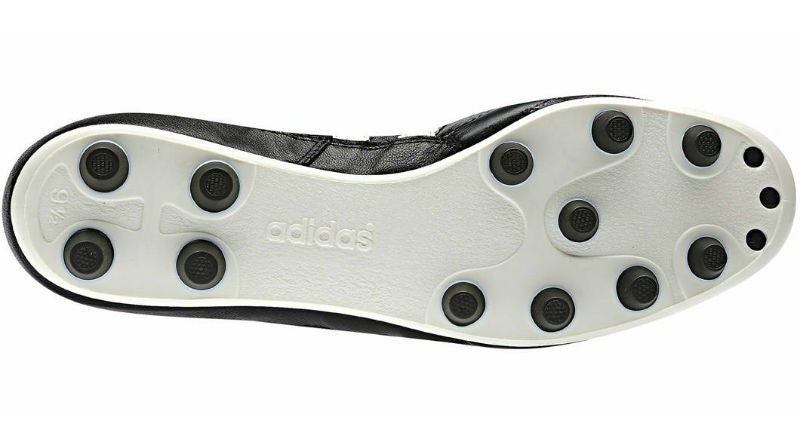
Do you have to choose your new football boot but don't know if the studs are the right ones for the field where you will play? Don't worry: ours guide to choosing the sole for the football boot will help you avoid mistakes and choose the ideal type of shoe for your needs.
COMPACT NATURAL GROUND SHOES (FG):

Le shoes (or boots) FG (firm ground) are the most widespread in the world of football footwear.
They have always been used for natural terrains (grassy or earthy) with a compact base. These are therefore soils that are neither too muddy or humid nor excessively dry.
Although they can also be renamed as shoes at 13, FG shoes can be found with a number of studs that can vary from 11 to 15. Over the years, the shapes of the studs have also changed and evolved. In fact, we have moved on from traditional round shape (which still remains on the market today) a more innovative forms like that one triangular or that lamellar.
Often they can also be found different cleat shapes together. The height of the cleat is medium and the material used is almost exclusively polyurethane (PU).
It is important to underline how FG shoes have triangular or round studs are multipurpose. In fact, they adapt to the game on third or fourth generation synthetic fields. Bladed studs are recommended for natural surfaces only.
ARTIFICIAL GROUNDS SHOES (AG):

The acronym AG (artificial ground) it is used for shoes suitable for fields with medium/low artificial pitches.
They are therefore earthly not particularly soft. This is a type of shoe that is definitely adaptable to circumstances.
Many also use it in case of frozen natural ground, as the rigidity and hardness of the studs is lower than that of shoes with FG soles. They are also very popular for the stability they are able to give to the foot and for the quick and fast response in shooting.
Cleats may have different shapes, but the shaped ones are prevalent conical or triangular. Compared to the latter, AG shoes have a higher number of studs. It should be underlined how, at times, the cleat itself can be "pierced", therefore with the internal part empty. It is in order to guarantee a traction designed specifically for synthetic fields.
Furthermore, the studs are evenly distributed on the sole, ensuring stability stable and constant support.
SOFT NATURAL/ARTIFICIAL GROUND SHOES (FG/AG):

Le shoes with type of sole FG/AG have been very successful in recent years.
This is also thanks to the growth of sstructures with third and fourth generation synthetic pitches.
They are in fact ideal for soft synthetic fields, similar to natural grass and not particularly hard, characteristics that the new synthetic pitches reflect perfectly.
They are equipped with multipurpose cleats, often with a round shape, to avoid trauma due to the stud itself getting stuck in the synthetic ground.
FG/AG shoes, therefore, are the synthetic grass shoes par excellence, but sometimes they can also be used on particularly low and dry natural soil fields. This is because the smaller than normal size of the cleat guarantees less stress on the foot on very rigid surfaces.
WET AND MUDDY NATURAL TERRAIN SHOES (SG):

Le SG shoes (soft ground) they are also known by the definition of 6 shoe.
They are ideal for tackling heavy natural fieldsi, with wet and muddy surface and which require a particularly strong grip.
The aluminum studs of these shoes are considered ideal for playing matches autumn or winter weather conditions.
The cleats have different heights. The 2 rear ones are in fact traditionally 16mm high, while the 4 in front usually have a height of 13mm. This height may however vary depending on the models.
The high height guarantees an excellent thrust into the soft ground. However, it restricts the use of these shoes exclusively on soft ground fields. In fact, if used on unsuitable surfaces, the extreme rigidity of the studs it would cause pain and strong stress on the foot.
WET AND MUDDY NATURAL TERRAIN SHOES (SG PRO):

The shoes with type of SG PRO sole (soft ground pro) are also known as mixed cleat shoes.
They are a relatively recent innovation in the world of football footwear. They were introduced by companies like Nike, Puma and Adidas.
These shoes are designed for natural fields with wet and muddy surface.
The substantial difference with SG shoes is the addition of studs (usually 4) in polyurethane. These dampen the penetrating action of the 6 aluminum studs, guaranteeing a faster and quicker response on damp terrain or with tall grass. Traction is therefore more effective.
These shoes are also popular with players with particularly delicate feet. In fact, they can suffer too much rigidity of the SG shoe studs.
HARD SYNTHETIC GROUND SHOES (TF):

They are also commonly called shoes from five-a-side football. Le TF or turf shoes (from turf, English definition of synthetic grass) are ideal for types of synthetic pitch that have a rigid surface.
They have a sole comprising a large number of small studs very low in height. These footwear allow you to have one snap and optimal traction, as well as not putting particular strain on the foot.
The shock-absorbing midsole endows them with a greater comfort compared to traditional natural grass field shoes. Also for this reason, they are particularly appreciated not only by those looking for them the shoe for the match with friends, but also come on footballers.
In fact, the latter, in the summer preparation period, facing intense workloads (we are talking about those to be carried out in the field), do not want excessive stress on the foot. They can also be used on fields with Extremely hard natural clay terrain and not even suitable for AG shoes.
INDOOR GROUND SHOES (IN):

Le indoor ground or futsal shoes they fall into a rather narrow category. They are in fact the the only shoes not to have cleats.
This is why they are intended only for surfaces suitable for the practice of futsal, then made in PVC, rubber or parquet.
The rubber sole guarantees one good adhesion on these types of terrain and often carries the wording NO-MARKING.
This is to point out that the sole itself not leaves marks or streaks on the playing surface (some particularly demanding gyms may request it).
The main feature remains however adherence that this type of sole can guarantee. Furthermore, the toe of this shoe may feature a reinforcement. In fact in futsal this area of the upper is more stressed than 11-a-side football.